
by Helene Brinkschulte, MSc (Hons) Quantum Technologies,
Oxford University
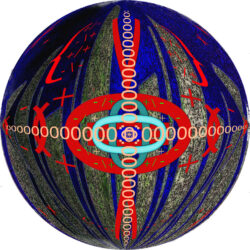
In quantum mechanics, the independence implied by classical distance breaks down: when two particles interact and separate, they can become entangled, meaning they share a single quantum state that cannot be described independently.¹ In such cases, measuring one immediately determines the possible outcomes for the other, regardless of their separation, challenging familiar notions of locality.² This does not mean a signal travels faster than light. Instead, entanglement demonstrates that quantum systems are represented as wholes, with outcomes governed by a joint wavefunction whose correlations cannot be decomposed into local parts.³ Once a measurement is made on part of that system, the mathematical description updates for the entire state.

A conceptual illustration showing two entangled particles.
Science Photo Library/Alamy Stock Photo
Einstein, unsettled by this non-local connection, called it “spooky action at a distance,” suspecting that hidden variables must complete the picture.⁴ But in 1964, John Bell proved that no local hidden-variable theory can reproduce quantum predictions,⁵ and experiments by Alain Aspect and later, loophole-free tests, confirmed that nature truly violates Bell’s inequalities.⁶ Today, entanglement is not just a curiosity but a practical tool, underlying quantum communication, teleportation, and quantum computing.⁷ Yet its interpretation remains debated. Does it point to connections deeper than space and time, or merely to the limits of classical reasoning? This article explores how major interpretations of quantum mechanics confront that puzzle: the Copenhagen view, which treats entanglement as a statement about knowledge and measurement; the Transactional interpretation, which sees it as a handshake across time; and the Pilot-Wave theory, which restores determinism through an explicitly nonlocal reality. Each, in its way, asks the same question: what does “separation” really mean in a quantum world?
The Copenhagen Interpretation: Correlation Without Connection
The Copenhagen view, the most familiar and pragmatic interpretation of quantum mechanics, holds that entangled particles do not exert any physical influence on each other across space. Developed by Niels Bohr and Werner Heisenberg in the 1920s, it argues that questions about underlying mechanisms are misplaced and that the focus should be on what can be known and observed.⁸ In this interpretation, the wavefunction is not a physical object stretching between particles, but a mathematical tool that expresses what can be known about the system as a whole.⁹ When two particles are entangled, quantum theory assigns probabilities to joint measurement outcomes, not to independent preexisting properties of each particle.
When one particle is measured, the correlated result for the other becomes known instantly-not because anything travels between them, but because the single wavefunction describing both has been updated.¹⁰ Measurement does not transmit a signal; it redefines what statements about the system can be made. As Bohr insisted, quantum phenomena cannot be divided into separate elements of reality; they must be treated as one indivisible process linking preparation, measurement, and outcome.8
In this sense, the Copenhagen interpretation transforms entanglement from a story about communication into one about completeness. It limits itself to what can be observed and predicted and offers no deeper mechanism.
The Pilot-Wave Theory: A World of Definite Paths
The Copenhagen view asks us to accept uncertainty as fundamental, but not everyone was willing to leave reality half-described. In 1927, Louis de Broglie proposed a bold alternative: that particles are always real, always somewhere, and always guided by an accompanying wave.¹² The idea faded until David Bohm revived it in the 1950s, showing that it could reproduce all the statistical predictions of quantum mechanics without invoking collapse or fundamental randomness.¹³

A walking two-droplet experiment visualising pilot-wave behaviour, based on Couder’s controversial experiment that suggested a macroscopic analog to quantum pilot waves.
Image source: https://doi.org/10.1051/epn/2010101
In Pilot-Wave theory, also called de Broglie–Bohm mechanics, the wavefunction is a real physical field obeying the Schrödinger equation.¹⁴ Each particle has a definite position, and the wave determines its motion through a precise guidance law. Once the initial conditions are set, the system’s evolution is completely determined. For entangled systems, the guiding wave extends over all particles at once: their motions depend on the total configuration, not on local surroundings alone.¹⁵ Measuring one particle constrains the outcome for the others, not because a signal travels between them, but because all are coordinated by the same non-local wavefunction.
In this picture, probability arises from ignorance, not indeterminacy.¹⁶ The apparent randomness of quantum experiments reflects our lack of knowledge about the exact initial positions of particles, not a fundamental uncertainty in nature. It is a return to realism, though one with a price: the guiding wave is inherently non-local and must link distant particles through the geometry of configuration space.¹⁷ Bohm accepted this without apology, arguing that relativity governs signals, not the deeper coordination of reality.¹⁸
The Transactional Interpretation: A Dialogue Across Time
Bohm’s theory restores certainty through determinism. The Transactional interpretation, introduced by John Cramer in the 1980s, restores symmetry in a different way by treating quantum processes as time-symmetric.¹⁹ Quantum mechanics has no built-in arrow of time; the Schrödinger equation works equally well forward or backward. Cramer proposed that every quantum event involves two waves: one moving forward in time from the emitter and another traveling backward from potential absorbers.²⁰ When these waves are mutually consistent, they overlap to form a transaction: a complete, closed exchange linking emitter and absorber. The transaction determines the actual transfer of conserved quantities such as energy, momentum, and angular momentum. In this view, a “measurement” is not the collapse of a wavefunction but the completion of such a transaction. Therefore, in an entanglement experiment, the entire setup, both particles and both detectors, forms one extended transaction across spacetime.²¹ The correlations observed between distant outcomes arise not from any influence passing between the particles but from the self-consistency of the completed transaction as a whole. In other words, the mathematics remains that of ordinary quantum mechanics, but the interpretation reframes quantum events as complete, time-symmetric interactions rather than one-way chains of cause and effect.²²
However, the interpretation faces its own challenges. For example, the backward-in-time confirmation waves raise questions about how they should be understood physically, and some critics argue that the formalism remains primarily heuristic rather than rigorously derived from the standard quantum framework.²³ Moreover, it can be questioned whether the transactions themselves have a clear ontological status or whether the theory fully avoids the ambiguities it seeks to resolve, as noted by Maudlin and Marchildon. ²³, ²4
Nevertheless, TI’s remains valuable as a distinctive attempt to make sense of quantum mechanics in explicitly spacetime terms, highlighting features of the theory that more familiar interpretations tend to leave implicit. By treating quantum processes as symmetric in time, it allows measurement and entanglement to be framed within a single, unified picture rather than treating them as conceptually separate problems. Moreover, TI avoids the need for an explicit collapse postulate, replacing it with a consistent completion of the underlying process. To many this is especially attractive since it recasts quantum events in terms that are easier to visualise, linking emitters and absorbers in a transparent spacetime narrative. At the same time, TI remains firmly within standard quantum mechanics, reproducing all its empirical predictions without introducing new dynamics. For these reasons, it serves as a distinctive interpretive framework that highlights structures in the theory that other interpretations often leave implicit, offering a way of thinking about quantum phenomena that is both internally consistent and conceptually clarifying.
The Significance of Entanglement
Entanglement is not just a conceptual puzzle but a physical resource. Quantum computers rely on entangled qubits to perform tasks beyond classical machines.²5 Quantum cryptography uses entanglement to detect eavesdropping, and quantum networks promise forms of communication once considered impossible.²6 Every one of these applications depends on the nonclassical correlations that once unsettled Einstein.
While physicists often treat the interpretations pragmatically, focusing on calculations rather than metaphysics, the question of why entanglement works continues to shape how we think about the universe. Philosophers and physicists such as Wheeler, Wigner, and Rovelli have suggested that information, observation, or relational properties may play a deeper role in constructing physical reality.²7 Whether or not these broader ideas are correct, they show why entanglement remains central not only to technology but to our understanding of what nature fundamentally is.
Lessons from Entanglement
Entanglement plays a significant role in quantum mechanics, revealing correlations that cannot be accounted for by classical theories and prompting ongoing examination of how quantum systems are structured. The interpretations surveyed here offer different paths through that conceptual landscape. The Copenhagen view emphasizes the limits of what can be meaningfully described, treating entanglement as a boundary of classical reasoning rather than a physical link across space. Pilot-Wave theory restores a form of realism, proposing hidden variables and a guiding wave that coordinates distant particles through an explicitly nonlocal dynamics. The Transactional Interpretation, in turn, frames quantum events as symmetric exchanges across time, weaving emitters and absorbers into a single spacetime process.
Each of these interpretations draws attention to different facets of the underlying puzzle. They highlight how quantum theory challenges assumptions about information, causality, and the nature of physical description in situations where correlations span large distances without transmitting signals. As entanglement becomes central to technologies such as quantum computation, secure communication, and emerging quantum networks, its conceptual implications matter even more. These developments encourage us to reconsider how quantum mechanics describes the world and to recognise that familiar intuitions about separation and influence may not align with the structure of quantum phenomena.
Seen in this light, entanglement reminds us that the universe cannot always be understood by analysing its parts in isolation. Whether regarded as a limit of knowledge, a hidden mechanism, or a symmetry in time, it suggests that connection itself is one of nature’s basic principles.
Bibliography
¹ J. S. Bell, Speakable and Unspeakable in Quantum Mechanics. Cambridge, U.K.: Cambridge Univ. Press, 1987.
² A. Einstein, B. Podolsky, and N. Rosen, “Can quantum mechanical description of physical reality be considered complete?,” Phys. Rev., vol. 47, pp. 777–780, 1935.
³ R. Horodecki, P. Horodecki, M. Horodecki and K. Horodecki, “Quantum entanglement,” Rev. Mod. Phys., vol. 81, no. 2, pp. 865-942, Jun. 2009.
⁴ A. Einstein, “Letter to Max Born, Mar. 3, 1947,” in The Born Einstein Letters, I. Born, Trans. New York, NY, USA: Walker, 1971, pp. 155–156.
⁵ J. S. Bell, “On the Einstein Podolsky Rosen paradox,” Physics (Long Island City, N. Y.), vol. 1, no. 3, pp. 195-200, Nov. 1964.
⁶ O. Freire Junior, “Alain Aspect’s experiments on Bell’s theorem: a turning point in the history of the research on the foundations of quantum mechanics,” Eur. Phys. J. D, vol. 76, no. 12, Dec. 2022
B. Hensen et al., “Loophole free Bell inequality violation using electron spins separated by 1.3 kilometres,” Nature, vol. 526, pp. 682–686, 2015.
⁷ R. Prevedel, M. Aspelmeyer, C. Brukner, T. Jennewein and A. Zeilinger, “Photonic entanglement as a resource in quantum computation and quantum communication,” arXiv, Mar. 2008.
⁸ N. David Mermin, “The Copenhagen interpretation of quantum mechanics,” Am. J. Phys., vol. 49, no. 10, pp. 940-943, Oct. 1981.
⁹ W. Heisenberg, Physics and Philosophy: The Revolution in Modern Science, Harper & Row, 1958, pp. 41-42.
¹⁰ J. A. Wheeler and W. H. Zurek (eds.), Quantum Theory and Measurement, Princeton Univ. Press, 1983.
¹¹ J. Roldán-Charria, “Indivisibility, complementarity and ontology: A Bohrian interpretation of quantum mechanics,” Found. Phys., vol. 44, pp. 1336-1356, 2014.
¹² L. de Broglie, “La mécanique ondulatoire et la structure atomique de la matière et du rayonnement,” Journal de Physique et le Radium, vol. 8, no. 5, pp. 225–241, 1927.
¹³ D. Bohm, “A suggested interpretation of the quantum theory in terms of hidden variables. I,” Physical Review, vol. 85, no. 2, pp. 166–179, 1952.
¹⁴ P. R. Holland, The Quantum Theory of Motion: An Account of the de Broglie–Bohm Causal Interpretation of Quantum Mechanics, Cambridge Univ. Press, 1993.
¹⁵ D. Bohm and B. J. Hiley, The Undivided Universe, Routledge, 1993.
¹⁶ S. Goldstein, “Bohmian mechanics,” The Stanford Encyclopedia of Philosophy, E. N. Zalta, Ed., 2021.
¹⁷ D. Bohm and B. J. Hiley, The Undivided Universe, Routledge, 1993.
¹⁸ D. Bohm, “A suggested interpretation of the quantum theory in terms of hidden variables. II,” Physical Review, vol. 85, no. 2, pp. 180–193, 1952.
¹⁹ J. G. Cramer, “The transactional interpretation of quantum mechanics,” Reviews of Modern Physics, vol. 58, no. 3, pp. 647-687, 1986.
²⁰ J. G. Cramer, “Advanced waves, quantum mechanics, and the transactional interpretation,” Foundations of Physics, vol. 14, no. 9, pp. 907–939, 1984.
²¹ R. E. Kastner, The Transactional Interpretation of Quantum Mechanics: The Reality of Possibility, Cambridge Univ. Press, 2012.
²² R. E. Kastner, Understanding Our Unseen Reality: Solving Quantum Riddles, Springer, 2015.
²³ T. Maudlin, Quantum Non-Locality and Relativity: Metaphysical Intimations of Modern Physics, 2nd ed., Malden, MA, USA: Blackwell, 2002.
²⁴ L. Marchildon, “Causal loops and the transactional interpretation of quantum mechanics,” Found. Phys., vol. 36, no. 8, pp. 1123–1130, 2006.
²⁵ M. A. Nielsen and I. L. Chuang, Quantum Computation and Quantum Information, Cambridge Univ. Press, 2000.
²6 A. K. Ekert, “Quantum cryptography based on Bell’s theorem,” Physical Review Letters, vol. 67, no. 6, pp. 661–663, 1991.
²7 C. Rovelli, “Relational quantum mechanics,” International Journal of Theoretical Physics, vol. 35, no. 8, pp. 1637–1678, 1996.